
KITPro Linux Server 1.1: a native installer and a qualified upgrade path
KITPro Linux Server 1.1 adds the native Installer 1.2, qualified custom storage plans, AppArmor, and a verified upgrade from 1.0.
Release record
KITPro Linux Server 1.1 · Final public release
Original release: . Retrospective release coverage. This article was published on . Created .
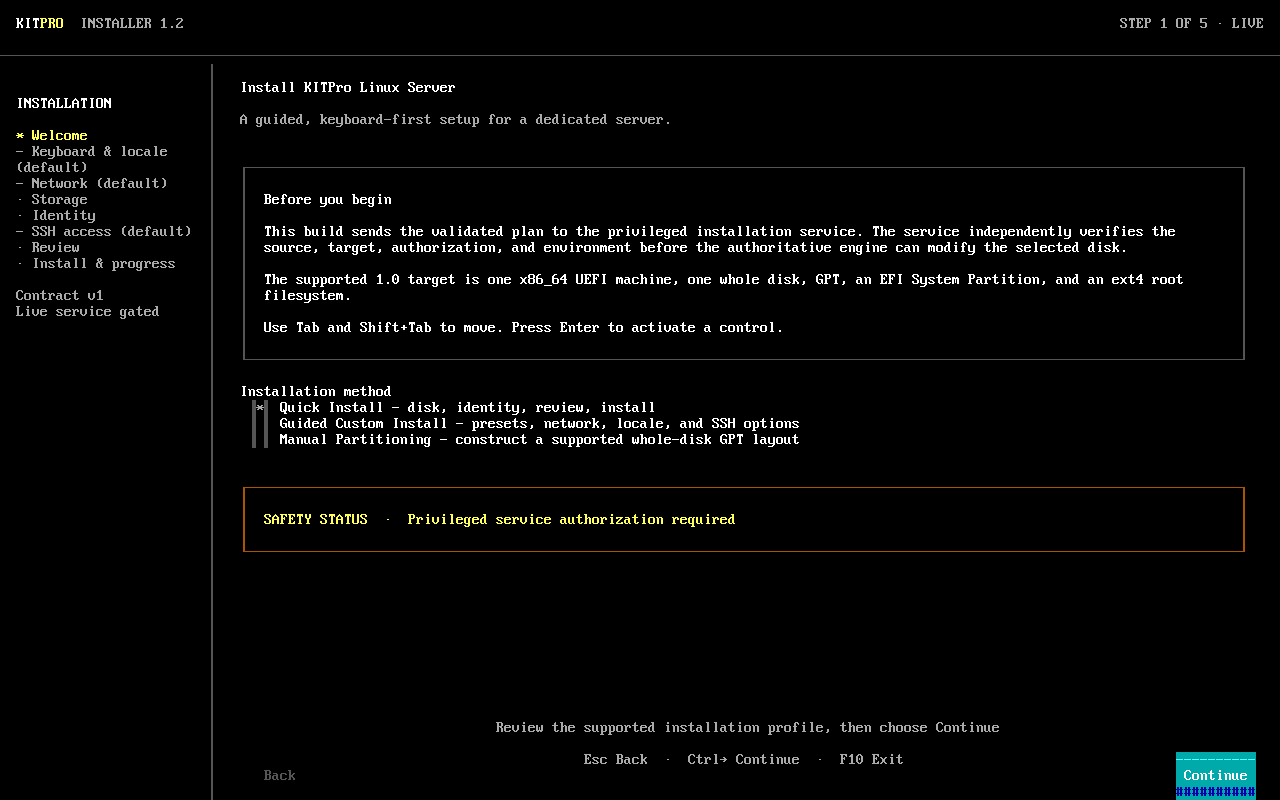
KITPro Linux Server 1.1 was published as a final release on November 1, 2026. It brings KITPro Installer 1.2.0, more flexible storage installation, Linux LTS 6.18.59, and the production-signed 1.1-g0001 package generation. For administrators moving beyond the original whole-disk ext4 workflow, the main change is the ability to review and authorize a broader set of storage plans through the native installer.
This is retrospective release coverage. The original software release date and this article's actual publication time are recorded separately.
Quick installation and custom storage
Quick Installation provides the standard ext4 layout. Custom Installation adds manual GPT layouts, Btrfs, native LUKS2 encryption, LVM, LVM-on-LUKS2, and encrypted swap. Qualified preservation and compatible EFI-reuse paths allow specific existing partitions and boot resources to be retained when the reviewed plan supports them.
Those capabilities do not imply general dual-boot support. RAID, general dual boot, and advanced multi-disk arrangements remain outside the qualified scope. Backups remain essential, including for a plan intended to preserve data.
The installer displays target identity and eligibility information before selection. Missing, ambiguous, stale, read-only, installation-media, and running-system identities fail closed. Physical installation uses a trusted-console AUTHORIZE confirmation. The backend binds that approval to the verified media, exact target and plan, a fresh inventory, an expiry, and single-use state. The short confirmation phrase does not bypass the checks behind it.
A new system baseline
Version 1.1 uses Linux LTS 6.18.59-1-lts, activates AppArmor, and introduces immutable signed generation 1.1-g0001. KITPro Console remains optional. It is neither installed nor enabled by default, and its application version is separate from the operating-system release.
Qualification covered Quick ext4, encrypted LVM, and preservation with EFI reuse in disposable QEMU environments. It also covered a production-signed 1.0-to-1.1 upgrade, previous-kernel fallback, interrupted-update recovery, and a physical Quick ext4 installation on the recorded Beelink configuration with WD PC SN540 NVMe storage and Intel I226-V networking. Physical evidence is limited to that configuration.
Upgrading an existing 1.0 system
The documented transition starts at generation 1.0-g0002 and ends at 1.1-g0001. Verify the installed generation, preserve administrator configuration and data, create a recoverable backup or snapshot, and confirm production repository signatures before authorizing the package-manager transaction. Do not substitute an Arch rolling-release repository or an untrusted local package directory.
After the transaction, reboot into the new LTS kernel and verify release identity, AppArmor, networking, DNS, SSH, and systemd health. Keep the 6.18.55-1-lts boot entry until the new kernel is accepted. Interrupted operations stop for inspection. Automatic rollback is not claimed; recovery uses the documented checkpoint. Downgrades and release-namespace substitution are unsupported.
Release artifacts and limits
The published final release intentionally supplies the frozen file kitpro-linux-server-1.1.0-rc1-candidate.17-x86_64.iso. Its retained candidate filename does not change the final GitHub publication status. The SHA-256 is 112955a88406f1a04364705df9e53b00449ab002699369cd511a8cad54cab36d.
Verify the detached signatures on SHA256SUMS and release-manifest.json with the production ISO fingerprint 607D71E399E645164471C8EBA998AA6B6095B621, then calculate and compare the ISO checksum. The attached manifest preserves qualification-time fields, including prepublication status and unsigned-ISO wording. The final public release record establishes publication; the signed checksum metadata authenticates the exact frozen artifact. Do not interpret these frozen fields as an ISO detached signature or as permission to change an artifact.
Installation requires an x86_64 processor, UEFI with Secure Boot disabled, at least 2 GiB RAM, and a target disk of at least 16 GiB. KITPro recommends 4 GiB RAM and 32 GiB or more storage. A USB installation drive must hold at least 4 GiB. Wired Ethernet is the qualified installation path. Secure Boot is unsupported. Review the release-specific installation guide and hardware compatibility before destructive installation. Standard support runs from November 1, 2026 through November 1, 2027.
- Official final release, downloads, and full release notes
- Installation guide
- Upgrade and recovery guide
- Artifact verification guide
- Released source
Download and verification files
Product screenshots